01 — Stone before steel
Ville-Marie began here in May 1642, when Paul de Chomedey de Maisonneuve and Jeanne Mance planted a fortified mission at Pointe-à-Callière, at the confluence of the Saint Lawrence and a creek since paved over. The name stuck to the whole city; the original settlement's footprint is now Vieux-Montréal, four centuries removed and still legible in the street grid. Walk rue Saint-Paul and you are on the oldest commercial street in the city, laid out when this was a fur-trading outpost, not yet a metropolis.
The Sulpicians arrived in 1657 and built the first Notre-Dame church nearby, on rue Notre-Dame, by 1683. What stands today is younger and more ambitious: James O'Donnell's 1829 Gothic Revival basilica, commissioned to seat 10,000 and designed, notably, by an Irish-American Protestant architect for a French-Catholic parish — a detail Monocle readers will appreciate for the quiet irony. O'Donnell converted to Catholicism shortly before his death and is buried in the crypt, the only person interred there.
“Un peuple sans histoire est un peuple sans avenir.”attributed proverb, common in Vieux-Montréal heritage plaques
02 — A market that became a parliament
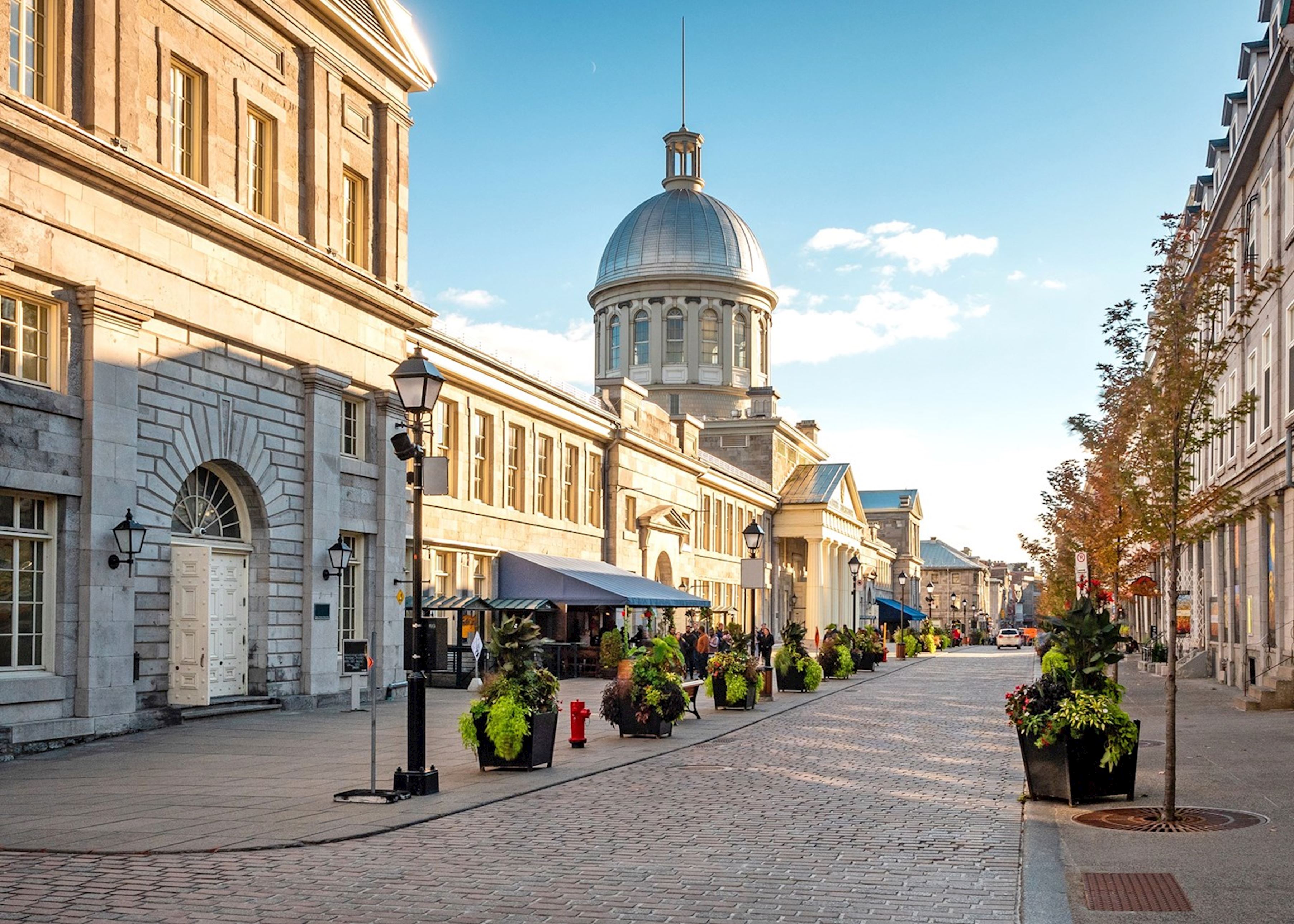
Marché Bonsecours opened in 1847, a neoclassical hall with a silver dome that was, briefly and improbably, the seat of the Parliament of the united Canadas in 1849, and Montréal's city hall from 1852 to 1878. It was, at the time, the largest town hall built in the country — a statement of a city arriving at metropolitan status faster than its institutions could keep up. Today the ground floor is Québec design and craft boutiques; the dome still catches light the way it did for aldermen a century and a half ago.
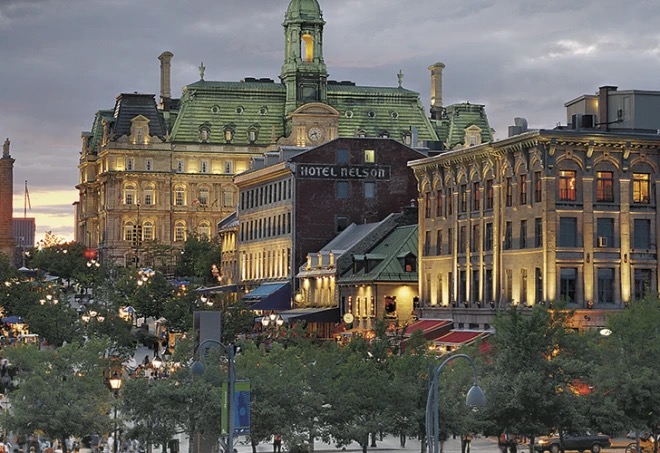
Downhill, Place Jacques-Cartier slopes toward the river from a column raised to Nelson in 1809 — Montréal's oldest public monument, predating Trafalgar Square's by three decades. The square itself was renamed for the explorer only in 1847, on the tricentenary logic of the era. It has been the city's street-life engine ever since: buskers, terrace tables, the Old Port at the bottom of the hill.
03 — The river working again
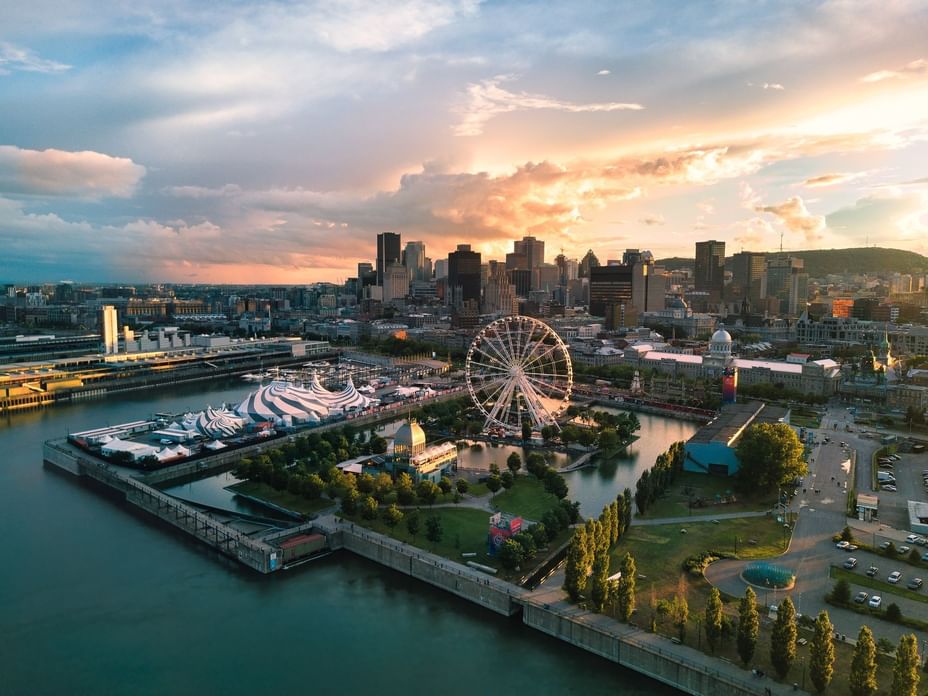
The Vieux-Port was working harbour into the mid-twentieth century — grain elevators, rail yards, the machinery of a river city. Its second life as public waterfront dates to the 1990s, and it now does double duty as parkland and stage. Cirque du Soleil, founded in Québec and headquartered in Montréal, pitches its Grand Chapiteau at Quai Jacques-Cartier for a hometown run most summers — the company literally returns to where it started.
Crew Collective, three blocks up rue Saint-Jacques, tells a parallel story of adaptive reuse. The Royal Bank of Canada built its head office there in 1928 — 22 storeys, briefly the tallest building in the Commonwealth — and vacated for good in 2012. Since 2016, the marble-floored teller hall has poured coffee instead of counting it, brass wickets intact. Old Montréal's trick, repeated all over the district: keep the stone, change the use.